Fears and Night Lights
Light from the Wild – Wolf Wall Lamp Sculpture in Unpainted Clay
The wolf is one of the few animals that humanity has never truly managed to domesticate symbolically. Even today, despite centuries of stories, myths, legends, and fears projected onto it, the wolf continues to exist in a space suspended between reality and imagination. It is a real creature that walks through forests, mountains, and silent landscapes — yet at the same time it inhabits dreams, childhood fears, ancient instincts, and collective memory.
We encounter the wolf long before we understand what it truly is.
In fairy tales it waits in the dark woods.
In legends it stalks the edge of civilization.
In nightmares it watches silently from the darkness beyond the fire.
And almost always, it is cast as the villain.
But the wolf has never needed our stories to become frightening. Its power comes from something older and deeper: the sensation that it belongs completely to the night, to instinct, to a world that exists outside human control.
This sculpture attempts to capture precisely that tension.
Not the wolf as a biological study.
Not the wolf as a fantasy creature.
But the wolf as psychological presence.
The head emerges from the wall like something suspended between trophy, apparition, and ancient guardian. The mouth remains open, frozen in a perpetual moment that feels impossible to interpret fully. Is the creature growling? Breathing? Warning? Calling? The ambiguity is intentional. The sculpture does not offer narrative certainty. Instead, it leaves the viewer alone with instinctive reactions.
And then darkness arrives.
Because this work was conceived not only as sculpture, but as illumination.
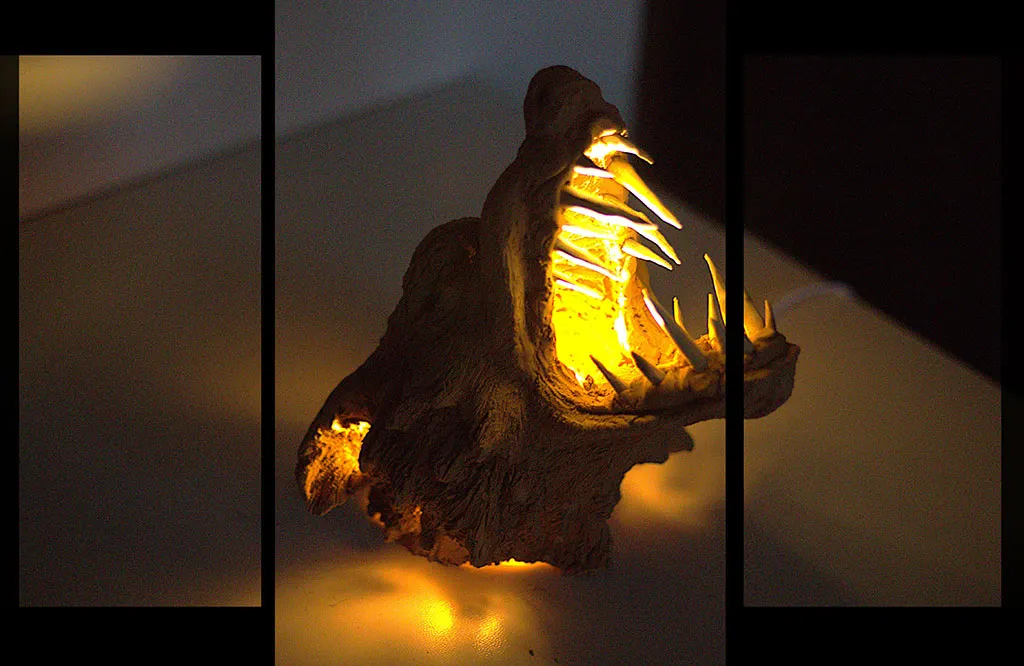
As night falls and the internal light source is activated, the wolf changes identity entirely. The open mouth becomes a source of dim glowing light, transforming the sculpture into a wall-mounted lamp capable of altering the atmosphere of the entire surrounding space.
The effect is not aggressive illumination.
It is presence.
A soft and unsettling light escapes through the mouth, spreading shadows unevenly across walls and surfaces. The creature no longer appears simply displayed — it begins to feel awake. The night, which is naturally the wolf’s territory, suddenly enters the room itself.
This transformation lies at the center of the work’s emotional identity.
The sculpture creates a fragile balance between fear and beauty, instinct and calm, darkness and warmth. The light softens the violence of the open jaws while simultaneously making the creature feel more alive. The viewer experiences contradiction constantly: comfort emerging from menace, atmosphere emerging from threat.
Unlike ordinary lamps designed only to illuminate efficiently, this piece uses light symbolically. Illumination becomes part of the narrative itself. The wolf is not simply lit — it becomes the source of nocturnal presence.
One of the most distinctive aspects of the sculpture is the deliberate decision to leave it unpainted.
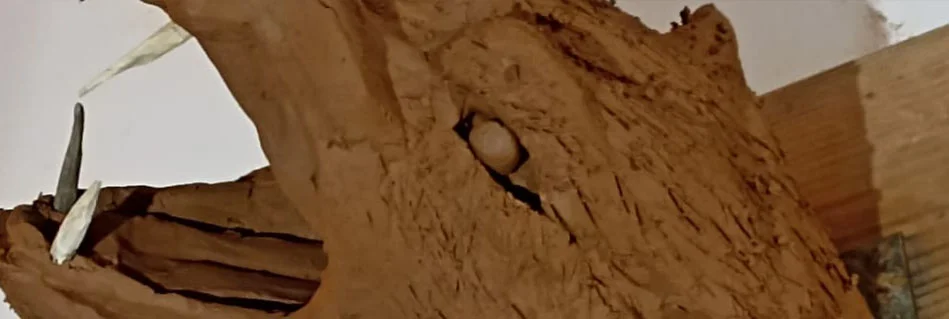
This choice was not made out of incompletion or neutrality, but intentionally, as part of the conceptual identity of the work. The raw clay surface preserves the primitive and material nature of the sculpture, allowing textures, modeling marks, and handcrafted imperfections to remain fully visible.
Without paint, the wolf feels older.
More archaeological.
More instinctive.
More honest.
The natural color of the clay reinforces the sensation that the creature emerged directly from earth itself rather than from polished decorative production. Every surface retains visible evidence of manual sculpting: scratches, folds, pressure marks, subtle asymmetries, and texture variations that would have disappeared beneath heavy coloration.
This raw aesthetic also creates a fascinating contrast with the internal light source. During daylight, the sculpture appears dry, silent, almost fossilized. But when illuminated from within, warmth suddenly begins to emerge through the primitive material, as if something dormant inside the clay itself were awakening.
The interplay between raw matter and living light becomes fundamental to the emotional experience of the piece.
The unpainted finish additionally allows the sculpture to interact naturally with minimalist and contemporary interiors. Rather than dominating the environment through excessive color, the work relies on form, shadow, and texture. This restraint makes the visual impact even stronger. The sculpture feels less like decoration and more like an architectural interruption — a primal presence embedded into the wall itself.
Mounted vertically, the wolf becomes part sculpture, part atmospheric object, part symbolic portal into darkness.
Lighting conditions dramatically influence how the piece is perceived. Under stronger ambient light, the textures of the clay become highly visible, emphasizing craftsmanship and sculptural depth. In darker environments, however, the illuminated mouth becomes the dominant feature, reducing the wolf almost to silhouette and glowing absence.
This dual identity allows the work to shift continuously between realism and dream.
The sculpture was designed for spaces seeking emotional atmosphere rather than conventional decoration: modern interiors, minimalist homes, artistic studios, mountain houses, cinematic environments, gothic-inspired spaces, alternative lounges, and interiors where lighting itself becomes part of the emotional architecture of the room.
The wolf has always represented contradiction in human culture.
It is feared, yet admired.
Wild, yet deeply social.
Dangerous, yet strangely noble.
This sculpture attempts to preserve that ambiguity instead of resolving it. The creature is not represented as pure monster nor romanticized spirit animal. It exists somewhere in between — ancient, instinctive, difficult to categorize completely.
And perhaps that is why wolves continue to fascinate us so deeply.
Because they remind us of something humanity tries constantly to suppress: the awareness that beneath civilization, routine, and artificial light, there still exists an older instinctive world that refuses disappearance.
A world of silence.
Of darkness.
Of cautious movement beyond the edge of visibility.
When illuminated at night, this sculpture becomes a quiet reminder of that forgotten territory.
Not through violence.
Not through spectacle.
But through atmosphere.
Ultimately, Light from the Wild is not simply a wolf sculpture or a decorative lamp.
It is a fragment of night attached to the wall.
A handmade object designed to illuminate not only a room, but the instinctive emotional space hidden beneath it.
- Work Name: Wolf
- Width: 20 cm
- Height: 20 cm
- Depth: 27 cm
- Weight: 2.5 kg
- Date: October 2025