PUTREFATION
Provocative Warthog Artwork with Disturbing Presence
This sculpture is not simply a warthog.
And no — this is definitely not the friendly Disney version singing happily through the savannah with a carefree philosophy about problems and sunsets. Anyone expecting a cheerful cartoon companion should probably turn around immediately. This creature has no interest in being reassuring, lovable, or marketable.
It exists for the opposite reason.
This work was conceived deliberately as a visual disturbance: an object designed not to comfort the observer, but to interrupt them. A presence that invades the room psychologically before it even occupies it physically. The sculpture does not ask permission to exist politely within a space. It imposes itself like an unresolved image that continues to remain in the mind long after the first glance.
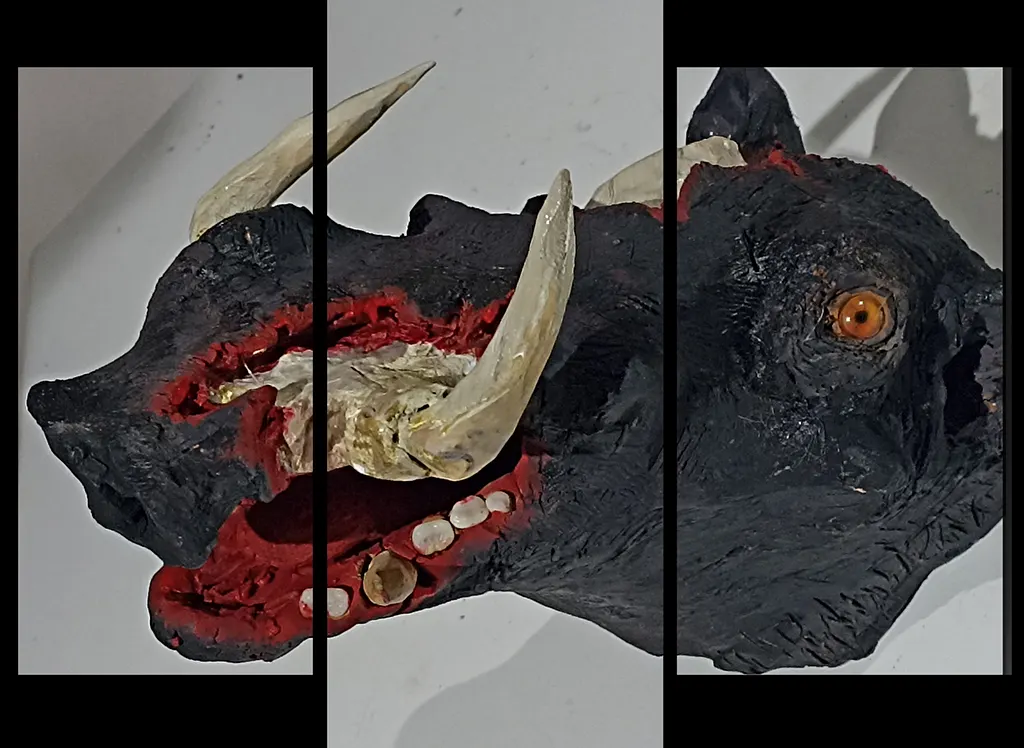
The head appears trapped in a suspended condition somewhere between survival and collapse. The mouth hangs open not in attack, but in abandonment — a cavernous void that no longer threatens anyone and yet still manages to disturb deeply. There is no theatrical scream here, no cinematic jump scare. Only a slow surrender of matter itself.
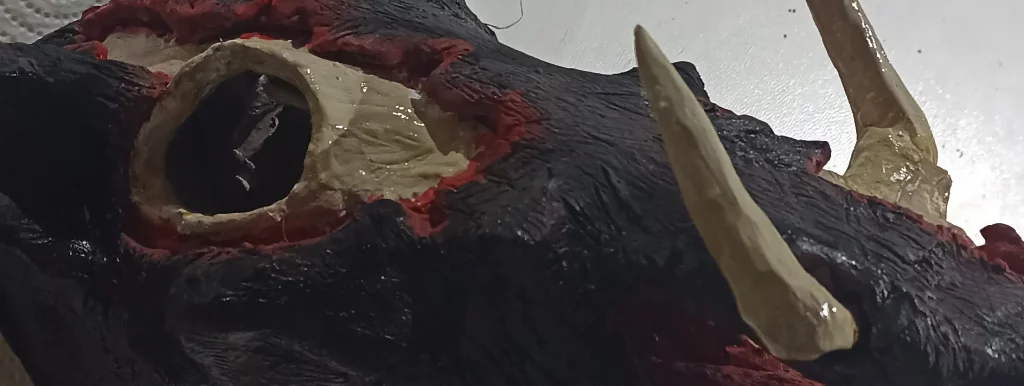
The tusks protrude from the flesh like exhausted relics. Once symbols of defense and aggression, they now resemble fragments left behind after the body has already stopped believing in its own strength. The skin folds inward, cracked and unstable, as though the creature were attempting to escape from beneath its own surface.
This sculpture is not about death as a dramatic event.
It is about decay as permanence.
That distinction changes everything.
Most representations of death attempt to soften it, stylize it, or transform it into something symbolic and digestible. Here, the opposite happens. The work insists on decomposition without elegance, deterioration without redemption, matter without illusion.
For some viewers, the reaction is immediate disgust.
And that reaction was intentional from the very beginning.
The sculpture was designed provocatively — visually and semantically — because uniqueness rarely emerges from safe choices. The goal was never to create a “pleasant” decorative object. It was to create something impossible to neutralize emotionally.
The open mouth becomes a confession rather than an attack.
The collapsing flesh becomes memory rather than anatomy.
The exposed surfaces become evidence of something the viewer instinctively wishes to avoid.
Because what truly unsettles people is not simply the grotesque appearance of the animal itself.
It is recognition.
Some viewers experience fear while looking at the sculpture, but not fear of the beast. What frightens them is the sincerity of the image. In the swollen textures, in the fragmented teeth, in the yielding flesh, they recognize the uncomfortable reality that every physical form eventually loses coherence and begins to surrender to time.
The warthog is not dead.
It has simply been decomposing emotionally for too long.
Others react differently. They move closer. Slowly. Carefully. They begin studying the details almost with respect. They notice the fractures in the skin, the layered surfaces, the dark reds that no longer resemble blood itself but rather the memory of blood. For these observers, the sculpture stops functioning as horror and begins functioning as testimony.
An atlas of erosion.
An anatomy of disappearance.
And then there are those who smile — but never comfortably. Their smile carries recognition rather than amusement. They understand that the sculpture speaks less about the death of an animal and more about emotional exhaustion itself: the slow internal unraveling that no one photographs because it is too real, too human, too close.
The creature does not attack anymore.
It confesses.
One of the most important aspects of the work lies in the experimentation behind its construction. The sculpture incorporates unusual material solutions specifically chosen to intensify discomfort and realism simultaneously. Artificial hairs were inserted into portions of the surface to create subtle tactile irregularities that reinforce the unsettling organic sensation of deteriorating flesh.
The eyes and some dental elements were developed using ready-made plastic components and unconventional materials integrated directly into the sculptural anatomy. These glossy surfaces create wet reflections under light, giving the disturbing impression that fragments of biological presence may still remain trapped inside the head.
The eyes are especially important.
Under focused lighting, they seem less sculpted than observed — as though the creature were still aware despite its collapse. This ambiguity between lifeless object and lingering presence becomes central to the sculpture’s emotional impact.
These experiments are not isolated technical tricks. They are part of a continuous creative philosophy present throughout many BartArt works: the refusal to remain trapped inside conventional sculptural methods alone. Clay constantly enters dialogue with synthetic materials, industrial textures, fibers, plastics, glues, and found objects capable of extending emotional realism beyond traditional craftsmanship.
The coloration reinforces this instability further. Deep reds, dark bruised shadows, and decaying tonal transitions were developed not simply to imitate biology realistically, but to evoke the psychological memory of decomposition. The colors appear contaminated by time itself.
Under dim lighting, the work becomes even more invasive.
Shadows sink into the open cavity of the mouth while glossy surfaces catch fragmented reflections unpredictably. The sculpture begins to feel less like an object and more like residue — something left behind after meaning itself has already collapsed.
And yet, despite all its brutality, the creature remains strangely passive.
Unlike the crocodile poised to strike or the Predator locked in predatory tension, this warthog no longer fights. The violence has already happened somewhere before the viewer arrived. What remains is aftermath.
Persistence.
Exposure.
This is precisely what makes the sculpture difficult to dismiss. It offers no resolution, no action, no catharsis. Only the prolonged presence of decay occupying space unapologetically.
As a wall-mounted installation or centerpiece inside contemporary dark interiors, horror-inspired environments, provocative galleries, collector spaces, or minimalist settings seeking emotional rupture, the sculpture transforms the room immediately.
Not by decorating it.
But by contaminating it emotionally.
Because Flesh Without Permission was never designed to be safe.
It was designed to remain inside the viewer like an image they wish they had never seen — while secretly being unable to forget it.
- NAME: Putrefaction
- DATE: December 2025
- MATERIALS: Clay/Wood/Plastic/Hemp
- WEIGHT: 2.8 kg
- Height: 18 cm
- Depth: 15 cm
- Thickness 28 cm